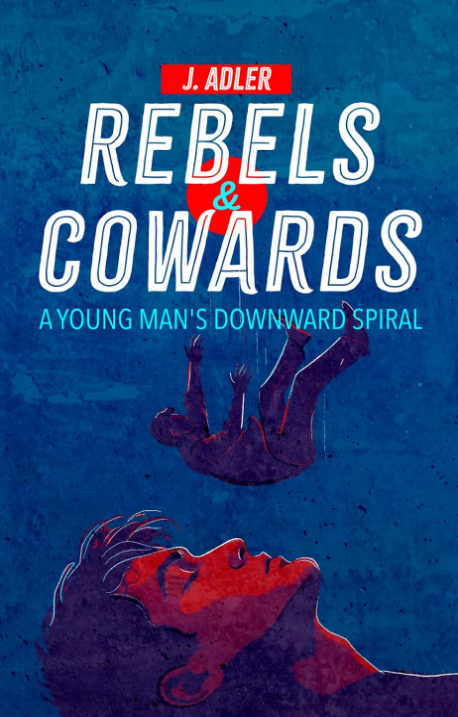
Title: Rebels & Cowards: A Young Man’s Downward Spiral
Author: J. Adler
Genre: Contemporary / Coming of Age
When 23-year-old Jackson Avila’s best friend and roommate, Jessie Khoury, is killed in a car accident, he is overwhelmed by grief and guilt. Forced to move back in with his strong-willed mother, Dahlia, disabled older brother Gonzo, and feckless stepfather Al, Jackson struggles to balance work, debt, and responsibility while confronting Jessie’s loss, which is threatening to define his life.
Rebels & Cowards is a raw, whip-smart, and emotionally resonant coming-of-age novel set in 2024 and primarily explores grief and family dysfunction through the lens of Jackson Avila.
The novel opens in January, directly into Jessie’s funeral. Jackson’s voice navigates the harrowing event with understated observational humor and a conversational tone.
However, this lightness of touch does not mask the young man’s grief. Adler ensures his reactions feel realistically relatable without diminishing the trauma. He has created an engaging, believable narrator in Jackson who convincingly propels this character-driven novel. The twenty-three-year-old’s voice is a blend of cynicism, humor, anger, and vulnerability that feels authentic and is addictive to read.
Rebels & Cowards reads like a memoir in several respects. Not only through Jackson’s chatty, intimate candor, but also because each chapter deals with a personal experience or important person in his life, filtered through memories and anecdotes. Many chapters are structured like private diary entries, which deftly increases the reader’s connection to and investment in Jackson.
This autobiographical quality is highlighted by a scattered series of illustrations. However, while they enhance the novel’s journaling, handmade slant, they feel limited in their narrative impact and merely decorative.
From Chapter 3, Jackson introduces his family, friend, Bo, and co-workers at the Mile High Coffee Cup shop where he is Lead Cashier. All are depicted with a level of nostalgic warmth and nicely individual quirks. A noticeable comedic energy flows through Jackson’s portrayals and reminiscences, which he unfolds at a buoyant pace. However, Adler skilfully ensures that the reader recognizes darker themes beneath Jackson’s humor, and Jessie’s loss is continually felt.
Throughout the early chapters, the rising tension between Jackson’s light-hearted, almost playful façade and his suppressed psychological struggles creates a lurking sense of foreboding and unease.
Indeed, the novel becomes more chronological and plot-driven from Chapter 12, “My Fortune Teller,” which is apt timing to maintain engagement. The following chapter delivers a major, shocking twist, with Jackson’s behavior becoming disturbing and the novel moving into different territory.
It is a credible, absorbing trajectory. Jackson remains likable and sympathetic, but the novel loses its, albeit appealing, superficial gloss and becomes an intriguing, unpredictable chain of events.
This is compounded by Jackson’s relationship with his therapist, Jeannie. Their intense scenes are among the novel’s strongest. Adler conveys their intimacy and sexual tension with sensitivity and nuance. Their dialogue also drops the humorous aspects. It’s revealing, showing the reader Jackson’s reflective, yet focused, side.
Nonetheless, Jeannie remains somewhat nebulous, which is understandable, but the conclusion involving her is somewhat unsatisfactory. Although Adler’s characters are written with fascinating complexity, some traits feel uneven. Dahlia, especially, whose protective nature is at frustrating odds with her failure to recognize the extent of Jackson’s emotional distress.
Al’s eccentricity often seems over-engineered and tips into absurdity, while Gonzo’s endearing charm occasionally becomes a touch irritating. Notwithstanding, both characters contribute heavily to the novel’s messy, emotionally rich texture and add layers of often amusingly surreal conflict.
Rebels & Cowards is a highly entertaining novel with a dark, compulsive heart and a strong main protagonist with broad appeal and empathy. Poignant, provocative, and fresh, Adler has produced a deceptively well-structured, well-written narrative that promises much for the hinted-at sequel.
This Editorial Review was written by the Book Review Directory staff. To receive a similarly honest, professional review for one of your own books, click here.

