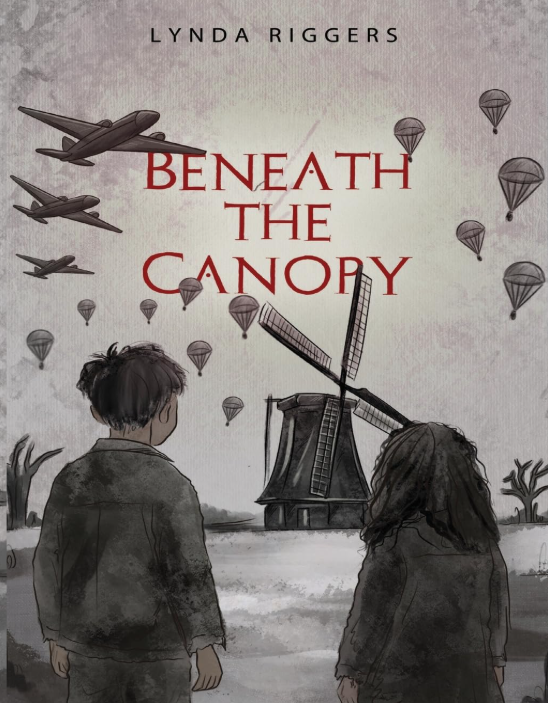
Title: Beneath the Canopy
Author: Lynda Riggers
Genre: Historical WWII / Middle-Grade Fiction
Inspired by her Dutch in-laws’ experiences, Beneath the Canopy tells the story of Johanna and Rein, two children about to turn twelve in Nazi-occupied Netherlands during the last eight months of WWII. Johanna from Arnhem struggles to protect her younger sister and pregnant mother, “Moeder,” while scavenging for food amid relentless air raids.
Nearly thirty kilometers away in Apeldoorn, orphaned Rein survives by stealing bread from a Nazi bakery. When fate brings the children together, they find in each other a much-needed friend and a bond of kinship forged by the trauma of war.
Riggers’s thoughtfully crafted novel opens with a well-curated Glossary providing foreign-language expressions, historical facts, WWII terminology, and cultural references. It keeps the novel accessible and authentic without interrupting the narrative and sets the tone for Riggers’s astute consideration of her audience.
Indeed, although Beneath the Canopy is aimed at children, it is far from juvenile. Riggers skillfully layers the narrative and writes with uncompromising depth and emotional honesty that grips adult readers, lending the novel multi-generational appeal while treating younger readers with intelligence and declining to sugarcoat the often-harrowing reality of her narrative.
The story begins in Arnhem in September 1944, two days before Johanna’s twelfth birthday. In a few paragraphs, Riggers places the reader in Johanna’s world. Her love for three-year-old sister Henny, concern for Moeder, whose portrayal is beautifully measured and understated, and her grown-up dreams are rendered with sensitivity.
Henny’s sunny depiction is the novel’s brightest thread. Riggers wondrously captures the toddler’s infectious energy without it becoming saccharine, using Henny’s joyful innocence as a contrast to the surrounding horrors. The little girl also drives several key plot developments.
Riggers’s writing is clear and immersive, grounded in Johanna and Rein’s sensory perception and vivid immediacy. She peppers the first chapter with ration coupons, breakfast gruel, and fear of bombing raids. She also makes the reader aware of Johanna’s coping mechanism, her internal counting, used to self-soothe and control terrifying situations.
Rich in detail, Riggers’s historical context is meticulously researched and cleverly applied. She escalates the opening chapters into sirens, panic, and Allied paratroopers being shot from the sky during “Operation Market Garden.” This traumatic spectacle becomes a focal point for her young protagonists and inspires the novel’s title.
Riggers alternates her short, fast-moving chapters, with the children’s narratives running in parallel. She is a skilled storyteller, her blend of history and fiction is original and compelling, and pace and plot are tightly controlled as it pivots between Johanna and Rein. Nonetheless, a few more serendipitous meetings between the two would have cemented their touching rapport.
Rein lives in starving chaos. A pitiful rubble-strewn existence where false bravado masks his vulnerabilities but not his impish spirit. The heartbreaking scenes with older brother, Pieter, are weighted with foreboding and adult complexity.
Rein’s friends, Wigman and Olderkotte, illustrate different aspects of the war. Wigman, damaged and aggressive, begins to afford the Nazis a twisted respect. Olderkotte, intellectual, gentle, and Jewish, refuses to give up hope of liberation, and the story could have used him more. Riggers seems to keep Olderkotte at the edges of the narrative, which makes him occasionally appear symbolic.
Oberführer Heinrich is possibly the most fascinating character, although his compassionate behavior toward Rein feels a little idealistic in parts. However, Riggers’s neatly comprehensive Author’s Note discloses that he is drawn from Rein’s recollections, making the Nazi officer’s nuanced actions sharply poignant.
Riggers has produced an evocative narrative that illuminates the realities of WWII in the Netherlands, and not just for middle-grade readers. Well-written, character-driven, and historically insightful, Beneath the Canopy deserves a broad audience.
This Editorial Review was written by the Book Review Directory staff. To receive a similarly honest, professional review for one of your own books, click here.

