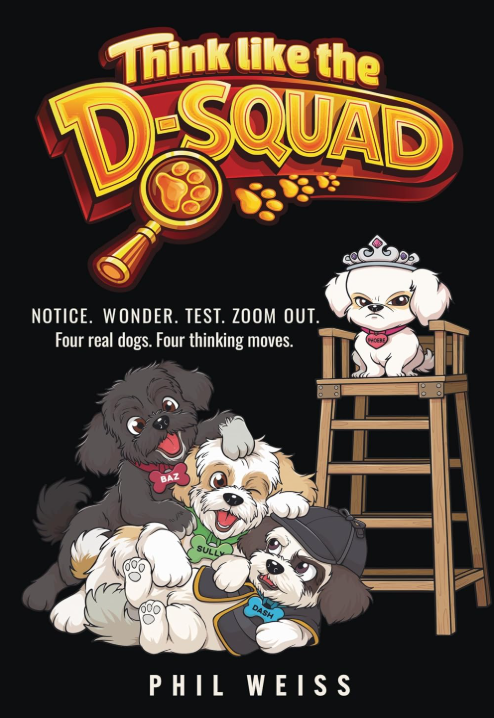
Title: Think Like the D-Squad
Author: Phil Weiss
Genre: Middle-grade
Phil Weiss’s Think Like the D-Squad is a critical-thinking book for kids between eight to twelve that teaches through four talking dogs telling stories. The dogs are based on the author’s real-life pets: Sully (who notices a problem), Baz (who wonders about the problem), Dash (who tests the possible solution), and Phoebe (who zooms out to ask the question everyone missed). Through interactive lessons shared as stories, a child grasps concepts to be used in real life.
Dash tells the stories from a dry-humored voice that adds fun to the stories that never feel like lessons. Adults can read this instructive book and enjoy it as much as kids. Dash’s reactions to Baz’s wild ideas are often the most humorous. Baz’s tongue hangs out of his mouth in every illustration, an adorable addition to his wondering mind. For example, he postulates that a bird feeder might be sad for the reason why its food keeps disappearing. Meanwhile, Sully is the eyes of the operation, but he often comes up with a theory about why something is happening without proof. Going back to the bird feeder, he assumes squirrels are the culprits, until Dash asks him. The dogs work well together, each demonstrating a critical step in problem-solving.
The book is divided into eighteen chapters, with a concluding chapter that brings all we’ve learned together. The chapter titles, such as “Ten Wrong Ideas Beat One Right One” and “The Loud One Only Sounds Sure,” demonstrate concepts like brainstorming and confidence. We can all relate to the “loud one” in the room, often the same one who believes they are right.
Besides being organized into chapters, the structure is easy to follow and helps keep concepts clear and simple to refer back to. The “Try This” section at the conclusion of every chapter creates a dare for the reader to put what they just learned into practice. Additionally, each chapter has a section called “Dash Checked It (Optional)” that goes into more detail about the research behind the lesson.
Phoebe plays a critical part in solving problems. By stepping back from the question, she gives the thirty-thousand-foot perspective, showing how reframing one’s thinking can prove essential for learning and answering questions.
Of special mention is the author’s note, in which Weiss brings a personal perspective to why he wrote the book. His twin sons were born premature and had some challenges. He also grew up attending remedial classes, so he understands some kids struggle more than others. This shows his heart behind the story and the lessons. Any parent who values their children’s education will be touched by this inclusion.
Philip Buen is the illustrator, and his designs add warmth and also break up sections into easy-to-read chunks. The illustrations are lovely and render sweet-looking, curious dogs.
The book contains significant back matter for adults: discussion questions, a glossary, and standards for educators. Weiss has created an all-in-one guide for critical thinking and problem-solving.
The book is 425 pages, with over 300 of story. This length might test the stamina of children who are more reluctant to read a longer book, even though the author has gone to great lengths to make the reader’s experience as pleasant as possible.
Think Like the D-Squad is warm, humorous, and useful for middle graders to learn problem-solving skills. Phil Weiss’s book needs to be in libraries, family rooms, and classrooms across the country. Think Like the D-Squad’s dogs will stay with the reader long after the book is closed, as will the lessons.
This Editorial Review was written by the Book Review Directory staff. To receive a similarly honest, professional review for one of your own books, click here.

