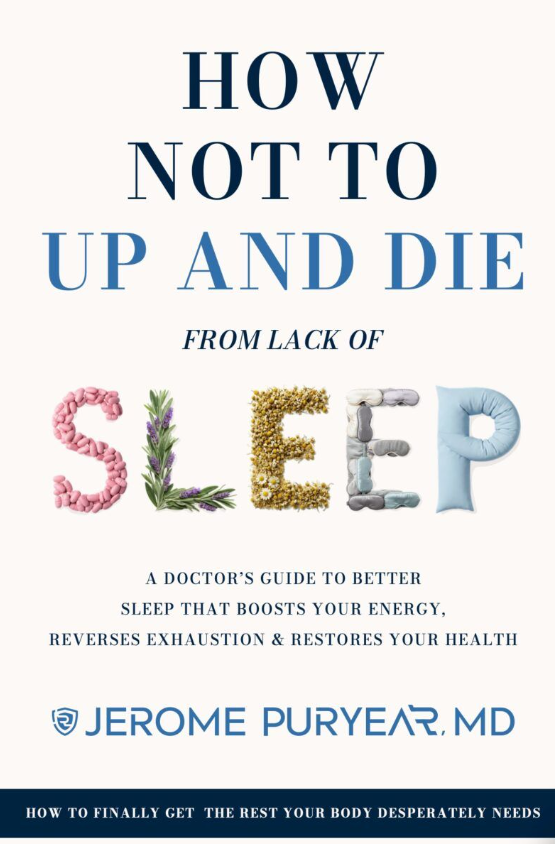
Title: How Not to Up and Die from Sleep Deprivation
Author: Jerome Puryear, MD
Genre: Self-help
Dr. Puryear has drawn on his intense personal experiences living with extreme fatigue during his time in medical school and residency, combined with early parenthood, and his diagnosis with obstructive sleep apnea to produce the extensive How Not to Up and Die from Sleep Deprivation, a holistic and scientifically backed guide to understanding, diagnosing, and treating sleep disorders and deprivation.
Organized into four main parts, each exploring different aspects of sleep health, Dr. Puryear has designed his comprehensive book to be read with flexibility. Each part is divided into chapters, some of which end with summary “Key Takeaways” for ease of reference.
Although the sections cover specific topics, the book’s thoroughness allows readers to jump to relevant sections without missing vital information. This does not mean there is excessive repetition or duplication for readers who wish to digest the book fully. Dr. Puryear adapts similar scientific facts and equivalent advice to the context.
Indeed, this is a polished, consummate, and exhaustively researched book. Dr. Puryear writes with an appropriately professional tone that befits his clinical authority.
Nonetheless, there is a warm, motivational edge, and by candidly sharing his severe sleep afflictions alongside other individual case studies, the book reads with a genuine sense of supportive empathy rather than medical formality.
After a conversational Introduction and Overview, Part I takes the reader from the Prehistoric Era to the modern day, concisely explaining how sleep habits have evolved before diving into sleep myths, mechanics, and common attitudes. It’s fascinating and thought-provoking.
Dr. Puryear does not simply regurgitate or repackage fundamental beliefs about sleep. He examines the biology and, also, the psychology of slumber, applying the science to behavioral patterns and problems. His knowledge is presented clearly yet without superficiality.
Aside from offering refreshingly sound advice, Part I is an engaging read sprinkled with illuminating insights, especially regarding the profoundly intrinsic importance of the circadian rhythm.
Part II continues this with an interesting look at individual chronotypes before covering symptoms, diagnosis, and treatment options, both natural and pharmaceutical, for a wide range of disorders and associated comorbidities. Dr. Puryear keeps paragraphs short and writes in plain, comprehensible language, using subheadings and bullet points while maintaining his systemic approach.
Part III is primarily aimed at shift workers. Again, Dr. Puryear provides a root-and-branch exploration of the difficulties posed by working non-conventional hours and offers advice on addressing them. Chapter 9 segues into a consideration of career change and success parameters. Although connective, it feels that this final chapter in Part III veers marginally off-topic.
Part IV is an invaluable toolkit of solutions, detailed, itemized, and discussed without bias, from simple breathing exercises to the latest tech gadgets and an in-depth analysis of medical marijuana. Dr. Puryear concludes his book with an extensive, meticulously documented Glossary, Appendices, and Reference section.
This manual forms part of the “How Not to Up and Die…” series, and it could be suggested that the colloquial prefix is possibly misaligned with the book’s content.
Notwithstanding, the phrase captures interest and provides a unique hook in a crowded marketplace. Additionally, although there are consolidatory tables and graphics, the inclusion of colored AI visuals, especially in Part I, seems too slick and also slightly inconsistent with the book’s substantive themes.
How Not to Up and Die from Sleep Deprivation is arguably one of the most comprehensive and accessible volumes on sleep deprivation for lay readers. For anyone struggling to find the embrace of Hypnos, Dr. Puryear’s book proves an indispensable guide offering a wealth of evidence-based knowledge, beneficial advice, and realistic recommendations in a digestible format free of gimmicks and jargon.
This Editorial Review was written by the Book Review Directory staff. To receive a similarly honest, professional review for one of your own books, click here.

