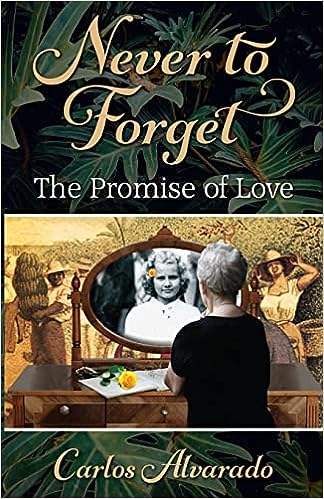
Title: Never to Forget: A Promise of Love
Author: Carlos Alvarado
Genre: Historical Fiction / Women’s Fiction
Never to Forget is a book of historical fiction based on the true story of one woman’s courageous journey to independence and self-determination throughout the tumult of mid-20th century Costa Rica, an abusive relationship, and eventually, an insidious disease that threatens to erase all that she is as a person.
It is split into two parallel storylines, switching from the present to the past with every chapter. The present focuses on the aftermath of Bertha’s diagnosis with Alzheimer’s disease and how her family deals with the effects of looking after someone with dementia. We then travel back in time to the 1940s for the other storyline: a standard coming-of-age story where Bertha boldly defines what it means to be a woman in a time when feminism was only in its infancy, and women were still living within the severely restricted boundaries that society has set for them.
At first, the alternating timelines did have an impact on the plot’s continuity and momentum. Just when things were starting to get interesting in the past, the chapter ends, and we’re back in the present, or vice versa. This may take some readers a bit of time to get used to, and it was only toward the middle of the book that we start to see how this may have been a deliberate artistic choice. The looming specter of Alzheimer’s disease is definitely one of the main characters of this book, almost as important as Bertha herself.
The emotional impact of seeing someone so strong gradually lose all sense of self cannot be put into words and is one the reasons why the non-linear, alternating timeline structure works. Seeing how she was in the past only underscored the changes that the disease has wrought in the present. The one thing that would have made it better was if each chapter were centered around a theme, and both past and present storylines were told within that context, just to make things feel more cohesive. In the end, the author was still able to resolve the themes and various threads into one satisfying whole.
People have always said the devil is in the details. One of the things that will draw readers into this book quickly is the skill and mastery with which the author sets every scene. No detail was spared to make Costa Rica come alive. From the political unrest to the hints of daily life in a plantation, from the religious undertones to the richness of Costa Rican cuisine, in addition to the melodious weaving of bits and pieces of the Spanish language throughout the text—it was all done so seamlessly, and the overall effect was a grounding, immersive, and pleasurable reading experience.
This book was a rich and vivid portrayal both of a life well-lived and the devastating effects of a condition that leaves you with a gradual loss of all sense of self, unable to remember that life and the people in it. It’s simultaneously raw, emotional, and empowered, as multifaceted as the strong and spunky character around which the book is centered. This is a must-read for anyone who loves a good story. After all, if we only learn one thing from this book, it is that we will always live on in some form or another as long as there is still someone alive who can tell our story, especially when we no longer have the power to tell it ourselves.
This Editorial Review was written by the Book Review Directory staff. To receive a similarly honest, professional review for one of your own books, click here.
 The Book Review Directory