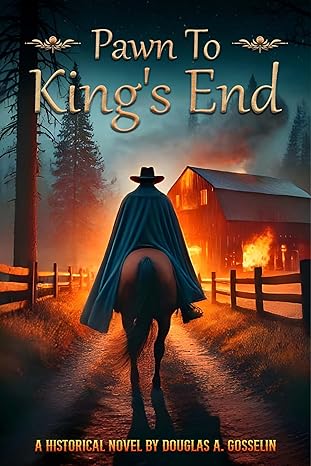
Title: Pawn to King’s End
Author: Douglas A. Gosselin
Genre: Historical Fiction
Opening in the mid-eighteenth century, Pawn to King’s End explores the brutal cleansing of the Acadian people from Nova Scotia by the British Crown and the subsequent attempt by American troops to capture Quebec during the Revolutionary War.
The narrative unfolds primarily through the experiences of the tenacious Gosselin family, especially son Clément. From fighting alongside the Indigenous Mi’kmaq, serving in the Canadian Regiment, and dealing with the merciless “Mr. Smith,” Clément refuses to relinquish the fight for freedom against overwhelming odds.
Pawn to King’s End is the first in Gosselin’s Secrets of the Republic trilogy. It’s an ambitious, far-reaching historical fiction that flickers into various sub-genres and dramatically shifts tone throughout its course. It often seems as though there are several competing books within one.
Nonetheless, the opening chapter is a beautifully luminous and atmospheric piece of writing. It instantly draws the reader in with its otherworldly, metaphorical quality, mainly due to the malevolent “Mr. Smith.” Smith is a fiendish, intriguing figure who appears throughout the sweeping storyline at crucial moments, infusing it with chilling, supernatural energy.
Following Smith’s shadowy entrance, the Gosselin family is introduced. The plot focuses on Gabriel, Marie, and their four sons, of whom Clément is the second eldest. Each possesses a quiet dignity and integrity, and these passages are absorbing. Gosselin evokes with equal conviction the rustic simplicity of Acadian farming life while preparing for an invasion by British forces.
Clément is immediately arresting. He is a gifted, enigmatic character with foresight and leadership skills beyond his teenage years. The brothers’ exile into the forest, which begins toward the end of Chapter 2, is one of the strongest areas of the novel.
It’s a psychologically charged masterclass in tension, paranoia, and rising fear. The dense woodland environment is utilized for its sharp, sensory effects while highlighting Clément’s affinity with an uncanny awareness of the natural world.
Although Clément is the intended main protagonist in Pawn to King’s End, he disappears for some while, and the barbaric expulsion of the Acadians is viewed through the eyes of Gabriel, Marie, and their friend, Jacques.
Gosselin writes with painstaking detail as the three are subjected to inhuman treatment. Their time of abject squalor in the hull of the Hannah is visceral and harrowing.
Each of these pretty weighty sub-plots involves arduous journeys. Briefly, Jacques becomes central, his quest back to Grand Pré and poignant dynamic with Marie deserving of their own novel.
Gosselin’s prose is straightforward yet elegant, with some lovely poetic flourishes. Dialogue is weighted with emotion, and characters often express profound sentiments, albeit succinctly, that resonate throughout the plot.
This changes just before two-thirds as the story jumps twenty years into Quebec City. The narrative and Gosselin’s writing become militaristic, with slightly academic interjections from an omniscient narrator. Although Clément’s espionage and revolutionary activities are gripping, there is a disconnect from earlier parts of the book. Indeed, Pawn to King’s End has the potential to be a mesmerizingly good historical fiction.
Notwithstanding, Gosselin’s research is meticulously thorough, and his blending of history and fiction is seamless and original. He is not afraid to make blunt authorial decisions. Although restricted by fact in many respects, his fictional and real-life characters and their consequences are treated in vivid, imaginative ways that are deeply emotive.
Gosselin has produced an epic, sprawling, and compelling novel for his series opener. Pawn to King’s End is a fascinating read that holds much promise for the following two books.
This Editorial Review was written by the Book Review Directory staff. To receive a similarly honest, professional review for one of your own books, click here.
 The Book Review Directory