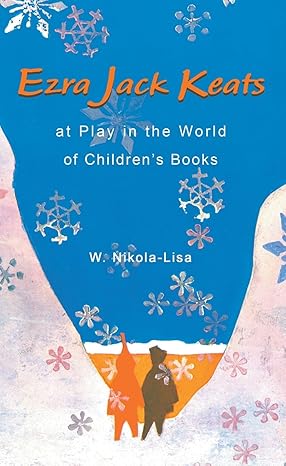
Title: Ezra Jack Keats at Play in the World of Children’s Books
Author: W. Nikola-Lisa
Genre: Literary Criticism
Ezra Jack Keats was a prolific children’s book author and illustrator born in Brooklyn in 1916. He wrote and illustrated 22 picture books, the most famous being The Snowy Day, published in 1962, which awarded him the Caldecott Medal for illustration.
In this fascinating volume, Professor Emeritus and recipient of the Ezra Jack Keats Research Fellowship, W. Nikola-Lisa, collects together his essays and articles analyzing the roles of play, creativity, imagination, and the child as an archetype in Keats’s work.
Nikola-Lisa’s Introduction advises that his book is “not an academic project” but a “celebratory exercise”. Indeed, although the foundations of his book’s content are academic, research, and study-led, there is no denying the rich seam of joyful appreciation that permeates Ezra Jack Keats at Play in the World of Children’s Books.
There is an immediate warmth and weight to Nikola-Lisa’s writing. His introduction is informal, inviting yet neatly structured. He shares personal details but only insofar as related to Keats, and a brief, focused overview of each Chapter.
The Snowy Day is the second picture book that Keats solely produced but probably his most well-known. Its central character, Peter, appears in a further six books.
Nikola-Lisa uses the nuclei of two previous articles in the opening chapter “Growing Up with Peter” as a touchstone to plunge into Keats’s world. Before focusing on Peter, he introduces the other recurring characters, their stories, and a look at Keats’s use of landscape.
Nikola-Lisa’s affection for Keats is obvious and quickly becomes contagious to the reader. However, his enthusiasm never detracts from an extremely polished, clear-eyed, and precise examination of his subject.
He opens up the concept of play from every conceivable angle. Solitary, social, and object play are all explored and accepted theories propounded before Nikola-Lisa reflects upon these criteria and perceptions of play and applies them to Keats’s books.
Moreover, as the title suggests, Nikola-Lisa looks at how Keats played with art techniques, namely mixed-media collages, to produce his picture books. Nikola-Lisa gives a detailed analysis of Keats’s artistic process, its literal and metaphorical layers, meanings, and motifs.
But, notwithstanding the studied evidence, which is immensely insightful and revealing, Nikola-Lisa has a flair for taking the reader with him as he springboards and segues effortlessly into territory that, at first glance, albeit highly readable, seems unrelated to Keats, such as his discussion of Zen philosophy in Chapter Five and the English Romantic movement in Chapter Ten.
Although they appear tangential, Nikola-Lisa never lets these interesting flights of fancy out of a carefully focused framework. The general narrows to the specific, then is refracted through Keats’s lens, often in surprising and thought-provoking ways.
Nonetheless, he nicely anticipates that, by Chapter Seven, too much theorizing could threaten to become abstruse, so he deftly changes the tone for Chapter Eight, providing a concise and absorbing biography of Keats before taking a less figurative approach to his work.
The only chapter that appears a touch removed is the compare and contrast of Keats’s only historical book, John Henry. However, Nikola-Lisa’s style is so captivating, that it becomes an engrossing detour.
Although he is adept in providing visual familiarity with Keats’s pictorial work, a few key illustrations might have provided clarity for the uninitiated Keats reader. Overall, the book is meticulously presented with an extensive bibliography and solid source referencing.
Ezra Jack Keats at Play in the World of Children’s Books is an engaging and illuminating exploration of a unique, pioneering talent. Comprehensive, approachable, and entertaining, Nikola-Lisa has produced an invaluable study for both Keats aficionados and those new to his work.
This Editorial Review was written by the Book Review Directory staff. To receive a similarly honest, professional review for one of your own books, click here.
 The Book Review Directory